You Cannot “Regenerate” Soil with a Chemical That Destroys It – Why Roundup Has No Place in True Regenerative Agriculture
A provocative question has been circling in sustainable farming circles: Is it morally right to use Roundup (glyphosate) as a “transition tool” in regenerative agriculture?
After examining the science, the ethics, and the legal landscape, the answer is definitive: No.
Let me explain why the argument against glyphosate wins – and why this isn’t just opinion, but a matter of ecological integrity.
The Core Conflict
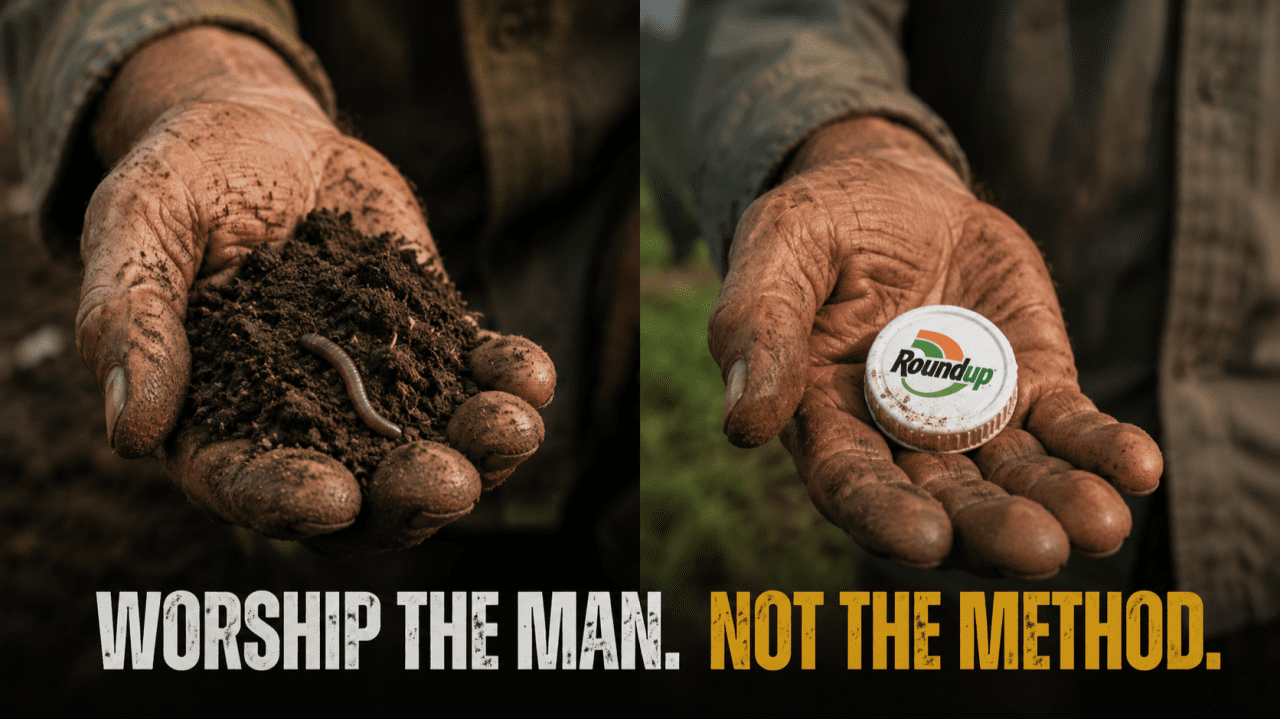
Regenerative agriculture rests on non-negotiable pillars: build soil biology, increase biodiversity, and eliminate synthetic inputs. Roundup, a broad-spectrum herbicide, does the opposite. It doesn’t just kill weeds. It chelates micronutrients, reduces earthworm populations, and directly harms arbuscular mycorrhizal fungi (AMF), the very organisms that build soil structure and deliver nutrients to crops.
The “transition tool” argument sounds pragmatic: a single, targeted burndown application to break a severe weed cycle or convert degraded land without tilling. But here is why that argument collapses:
1. The Definitional Boundary Matters
Regenerative agriculture isn’t “less bad” than industrial farming. It actively restores living systems. Once you authorize glyphosate for one tough season, the economic and psychological dependency takes over. The contradiction becomes routine. You cannot claim to regenerate soil while weakening its food web.
2. Ecological Harm Is Non-Negotiable
AMF networks killed by glyphosate can take years to recover. Soil biology has no memory. Applying the herbicide in year one undermines the very foundation you are trying to build in year five. Established regenerative farmers have converted degraded land without glyphosate, using intensive cover cropping, high-density livestock mob grazing, solarization, and mechanical termination. The barrier is time and knowledge, not physical impossibility.
3. Health Justice and the Legal Reality
The moral case is reinforced by a growing legal consensus. Globally, thousands of lawsuits have linked glyphosate-based herbicides to non-Hodgkin lymphoma. Key legal developments include:
- Bayer (Monsanto) settlements: Over $10 billion USD to resolve approximately 100,000 lawsuits, with juries consistently ruling that the company failed to warn of cancer risks.
- International actions: Germany, France, the Netherlands, and Vietnam have restricted or banned glyphosate for non-professional use. The EU’s renewal of glyphosate was narrow (2023) and remains politically contested, with several member states opting for national bans.
- Ongoing litigation: New cases continue to emerge, including claims of Parkinson’s disease linkage and environmental damage to waterways.
India – Status as on date
- Import is “Free” but Regulated: The central government allows import, but only if the importer has a Certificate of Registration from the Central Insecticides Board & Registration Committee (CIB&RC) .
- Usage is Restricted: You cannot just buy it off the shelf. Current rules allow application only through licensed Pest Control Operators (PCOs) to prevent indiscriminate use by farmers.
- State-Level Bans Exist: Some states, like Punjab, have banned specific formulations (such as Ammonium salt of Glyphosate) due to soil health and carcinogenic concerns.
- Pending Legal Review: A fresh scientific review is currently underway following a Delhi High Court order, with the next hearing scheduled anytime soon this year.
Regenerative agriculture claims to care about people and place. Accepting legal liability exposure (for the farmer) and health risks (for farmworkers and downwind communities) contradicts that ethic entirely.
The Winning Argument: Ecological Integrity Over Short-Term Convenience
The pro-Roundup “transition” argument treats regeneration as an endpoint that justifies a toxic means. That is a moral mistake.
True regeneration uses biological weed control: diverse rotations, cover crops, roller-crimpers, and planned grazing. If a practice requires glyphosate, it isn’t regenerative agriculture. It’s reduced-till industrial farming with green branding.
The Path Forward
For farmers facing severe weed pressure or degraded land, the harder but defensible path exists:
- Accept lower yields temporarily during transition.
- Invest in mechanical termination (roller-crimpers, weed whackers on tractors).
- Bring in livestock to break weed cycles.
- Access cost-share programs for organic transition (EQIP in the US, similar schemes in the EU). (EQIP is Environmental Quality Incentives Program) is a voluntary USDA-NRCS program providing financial and technical assistance to farmers, ranchers, and forest landowners for implementing conservation practices
- India also have some programs similar to the US EQUIP designed to assist farmers and landowners with conservation. These include technical support for land management and initiatives like the National Mission for Sustainable Agriculture.
- Besides above, National Green Tribunal (NGT) in India can, through its orders, mandate that funds, specifically those from environmental penalties or fines, be channeled into restorative ecological projects, including regenerative agriculture. The NGT emphasizes soil health, promoting initiatives that reduce chemical dependence, which aligns with regenerative and natural farming approaches.
No one said regeneration is easy. But calling a chemical-dependent system “regenerative” does not make it so.
Final Thought
The movement is increasingly clear: synthetic herbicides are incompatible with regenerative core values. The legal and scientific winds are shifting. The better moral path is slower, cleaner, and honest.
You can read more articles like this HERE