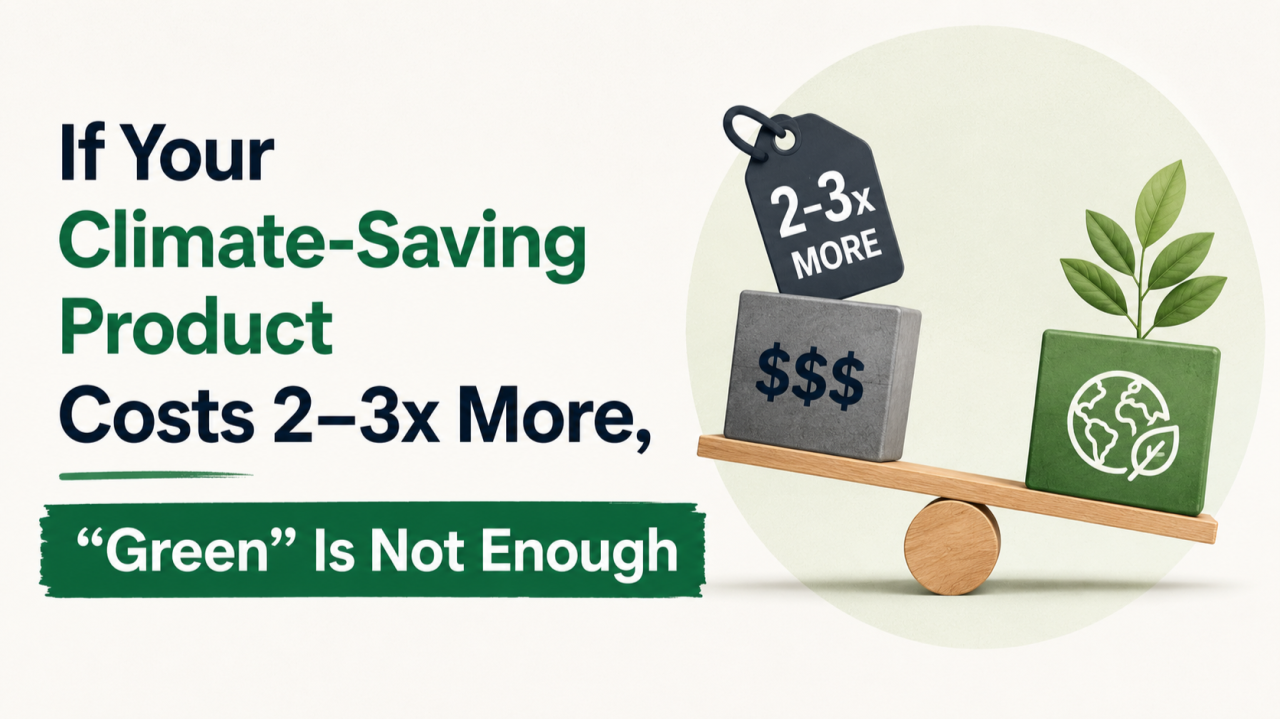
If Your Climate-Saving Product Costs 2–3x More, “Green” Is Not Enough
A planet-saving product can still fail in the market.
That is the uncomfortable truth many climate-tech and sustainable-materials companies face. If the alternative is 2–3x costlier than the incumbent, customers may admire it, investors may praise it, and policymakers may support it — yet procurement teams may still say: “Not at this price.”
This is the strategic challenge at the heart of this case study.
Algocol Limited is a sustainability-driven packaging company developing Algacol, an algae-based alternative to thermocol or expanded polystyrene (EPS) foam. The company has built a state-of-the-art automated manufacturing facility, backed by patient capital, supported by strong quality control, and led by a founder focused on automation, cost reduction, and product performance.
Its product is not merely “green.” It is designed to be strong, lightweight, waterproof, fire-resistant, anti-static, and capable of protecting goods through demanding drop-test conditions.
Yet Algocol Limited faces the classic climate-tech scaling problem: its solution is currently 2–3x costlier than thermocol.
EPS is cheap, familiar, lightweight, and convenient. It is also a serious waste problem: it does not biodegrade, breaks into microplastics, and is difficult and expensive to recycle at scale.[1] [2]
So what should Algocol Limited — or any company with an environment-saving but costly product — do to survive, thrive, save people and the planet, and remain profitable?
The answer is simple, but not easy: stop selling sustainability as a moral argument and start selling it as a business advantage.
- Win the Right Customers First, Not Every Customer
A costly sustainable product should not begin by trying to replace thermocol everywhere.
That is a trap.
The first customers should be those for whom failure is expensive: electronics, premium appliances, exports, fragile goods, regulated industries, high-ESG brands, and companies facing real compliance pressure.
For these customers, the conversation is not “this box is greener.” It is: this packaging can reduce damage, protect your brand, support ESG reporting, lower regulatory risk, and help you win customers who care about sustainability. That changes the buyer’s mental model from “expensive substitute” to strategic risk-reduction tool.

The early market is not the mass market. The early market is where the pain of not switching is already high.
2. Compete on Total Cost, Not Unit Price
Thermocol wins because it looks cheap. But many “cheap” products are only cheap because the environmental, compliance, waste-management, and reputational costs are not fully priced in. Algocol Limited should build a total cost of ownership model for every large customer. The sales pitch should quantify:
- “How much product damage can be reduced?”
- “How much packaging volume can be lowered?”
- “How much ESG reporting value is created?”
- “How much future EPR or compliance exposure is avoided?”
- “How much brand differentiation is gained?”
The global green packaging market is already moving in this direction. Fortune Business Insights estimates the market at USD 362.01 billion in 2025, projected to reach USD 732.33 billion by 2034, driven by regulation, consumer demand, circular economy practices, and material innovation. [3]
That means the market is not asking, “Will sustainable packaging matter?” It is asking, “Who can make sustainable packaging operationally and economically viable?”
3. Sell a System, Not Just a Box
If Algocol Limited only sells a product, procurement will compare it against thermocol. That is a losing battle in the early years. Instead, the company should sell a system: packaging plus compliance support, reporting, reverse logistics, EPR alignment, and measurable impact data. This is where sustainable packaging can move from being a cost centre to a boardroom solution. India’s plastic waste framework already places growing responsibility on producers, importers, and brand owners through Plastic Waste Management and EPR-related mechanisms.[4] For companies under pressure to show credible ESG progress, a packaging partner that helps simplify compliance is far more valuable than a vendor selling “eco-friendly material.”
The business model can include:

This is the shift that matters. The company should not ask customers to “pay more for green.” It should help them earn more, risk less, and report better by switching.
4. Use Policy as a Tailwind, Not a Crutch
Policy can accelerate adoption. But waiting for bans, court directives, or mandates is not a business strategy. It is a hope strategy. Regulation should be treated as a tailwind, not the engine. The company should actively work with policymakers, industry bodies, retailers, logistics companies, and large brands to create category standards for compostable, biodegradable, and high-performance protective packaging.
At the same time, it should generate hard proof: lifecycle assessments, certifications, customer case studies, damage-reduction data, compostability evidence, and cost-down milestones. Activists can create urgency. Policymakers can create pressure. Investors can provide patient capital. But only customers can create recurring revenue.
The company survives when policy supports the business model. It thrives when the business model works even before policy forces the market to change.
5. Build the Cost-Down Flywheel
The biggest challenge is the classic chicken-and-egg problem. Costs fall with scale. But scale comes only when customers buy. To break this loop, Algocol Limited needs a cost-down flywheel. Focus on high-value beachhead segments. Use them to generate revenue, data, and credibility. Standardize designs wherever possible. Too much customization kills scale. Use automation and capacity utilization aggressively. Idle capacity is hidden cost. Partner with anchor customers. Multi-year offtake agreements can unlock better financing and production planning. Make impact measurable. Every shipment should create data the customer can use in ESG, marketing, and compliance communication.
The sustainable packaging market is large, but it is not forgiving. Fact.MR projects global sustainable packaging to grow from USD 314.8 billion in 2025 to USD 669.7 billion by 2035, with India expected to be one of the faster-growing markets. Growth will reward companies that combine mission with margins. [5]
The Strategic Choice
- For founders, this is a positioning challenge.
- For investors, it is a scaling challenge.
- For marketers, it is a narrative challenge.
- For policymakers, it is a market-design challenge.
- For activists, it is a systems-change challenge
But for the company itself, the path is clear: do not sell guilt; sell value. Do not sell material; sell outcomes. Do not wait for regulation; build customer economics that regulation will later amplify.
A costly environmental product can survive only if it proves it is more than environmentally correct. It must be operationally superior, financially defensible, policy-aligned, and emotionally compelling. That is how climate-positive companies move from pilot projects to mainstream adoption. That is how they save the planet without sacrificing profit. And that is how they earn the right to scale.
The real question is: should sustainable products keep trying to become cheaper than harmful incumbents — or should markets, policies, and investors get better at pricing the true cost of “cheap”?
References
1.Beyond Plastics, “The Problems with Expanded Polystyrene (a.k.a. EPS or Plastic Foam),” https://www.beyondplastics.org/fact-sheets/polystyrene
2.Global Seafood Alliance, “Expanded polystyrene is a ‘waste nightmare’ but could non-EPS seafood packaging reduce ocean pollution?” https://www.globalseafood.org/advocate/expanded-polystyrene-is-a-waste-nightmare-but-could-non-eps-seafood-packaging-reduce-ocean-pollution/
3.Fortune Business Insights, “Green Packaging Market Size, Share & Industry Analysis,” https://www.fortunebusinessinsights.com/green-packaging-market-105113
4.Central Pollution Control Board, “Plastic Waste Management Rules and EPR resources,” https://cpcb.nic.in/rules-4/ and https://eprplastic.cpcb.gov.in/
5.Fact.MR, “Sustainable Packaging Market Size and Share Forecast Outlook 2025 to 2035,” https://www.factmr.com/report/sustainable-packaging-market
You can read more articles like this HERE